Fools Who Keep Silent…

Yesterday a story hit the news (or at least some popular blogging sites) displaying screen-capture photos of an Alaska high school student’s facebook wall.  The photos in question document a conversation that took place between the student and some of his peers regarding the new television show “Sarah Palin’s Alaska”.  In this conversation, Willow Palin (the ex-governor’s 16 year old daughter) is shown to have joined in the debate about whether or not her mother’s show is “failing so hard right now”.

The conversation that follows is not unlike any other heated conversation that takes place on facebook.  Many of the people involved are rude, crude and generally hateful to one another – and expletives get tossed around like they are going out of style.  There is no fear of repercussion because it’s a semi-private conversation – only their friends can read what they’ve written, so there is plenty of room to speak their minds (and plenty of friends to cheer the fight on).

But here’s the rub:  it’s not really private at all.

As Willow Palin discovered this week (and as an Arkansas school board member learned a few weeks ago), nothing is truly private on facebook.  You can click the boxes that say “friends only” and revisit your privacy settings every single day, but all it takes is one person in your friend list who decides it is worthwhile to share your information…and then the whole world not only knows your business, but they also know precisely how you chose to state your business.  Whether it is the racist or homophobic slurs you used against someone in an argument, a photo of that party you “never went to”, or a rant about how much you loathe your American History teacher, these things can all become public knowledge in the blink of an eye.

So, was it their fault that these “private” conversations found their way to a national audience?  In the strictest sense, no.  In each instance I’ve noted, the decision to send a screen shot to a news agency was the decision of another individual, and the individual’s motives are not known.  It could have been about money, or fame, or causing trouble – and it could have been about exposing someone for who they really are so that others can know a truth about them.  But for our purposes the motives don’t really matter – what’s done is done.  The point is that we have the power to keep these painful public brouhahas from happening to us.  And what is this power?  It’s the power to pick and choose what we put up on the Internet – the power NOT to run our mouths.

To begin with, racism, sexism, xenophobia and homophobia are not good things.  Whatever your religious values, there is simply no virtue to be found in being hateful.  If slurs and other demeaning statements are part of your day to day speech, then you should consider shutting your mouth while you ponder the roots of your hatred.  Hatred isn’t good for life – not yours, not mine, not anyone else’s – and it isn’t good for your faith, so spend your newly acquired time in silence uprooting that barren vine before it completely chokes your spirit.

Likewise, it generally isn’t a good idea to break laws, destroy property, over-indulge in harmful or obnoxious ways, strip publicly, etc.  It also isn’t very smart to have a camera with you while engaging in any of the aforementioned behaviors.  We do all make mistakes from time to time (you’ll certainly never hear me claim perfection, unless it’s done in a VERY tongue-in-cheek way), but is it wise to post those indiscretions on our facebook walls for all our friends (and, perhaps, the world) to see?   Ummmm…no.

The Book of Proverbs has a lot to say about Wisdom (Sophia) and foolishness…and though the Internet wasn’t really a concern of the Old Testament authors, this collection of wisdom sayings speaks volumes to the issue at hand.  For example:

“Those who guard their mouths
preserve their lives;
those who open wide their lips
come to ruin.”   (Proverbs 13:3  NRSV)

“Even fools who keep silent are
considered wise;
when they close their lips, they are
deemed intelligent.”  (Proverbs 17:28  NRSV)

It seems, even a few thousand years ago, the wise knew that while it was best not to make poor choices at all, it was also particularly inadvisable to broadcast their mistakes.  While we should all strive to be the best people we can be (the people God hopes we will be), we will mess up from time to time.  That is inevitable.  But when we do mess up, when hateful things spring up in our hearts and start edging their way towards our mouths (or our fingertips), we should make the next wisest decision available:  be silent.

At least then, in our silence, we won’t find things we’ve said on our facebook wall in the hands of our parents, our teachers, our co-workers or displayed on the Huffington Post…


Autumn Wonder

The day I have impatiently waited for has finally arrived:  It is now consistently autumn here in the Kansas City metro area.  Daily highs are in the low sixties and upper fifties…the trees are slowly changing from green to gold to amber/orange and on to brown…the townie-geese are receiving their annual out-of-town visitors, many of whom will make this their residence throughout the chill of winter…  Yes, it is Autumn.  Thanks be to God!

Autumn has always been my favorite season.  Much of it has to do with the trees – the way they put on such extravagant dress for a few brief weeks before baring it all in the name of winter.  There are so many other things that I love about the fall – and in the name of gratitude and joy-centered living, I think this is the time to list them:

In the midst of Autumn, I love:

  • the crisp, clear quality of the air.  It is as though one can see farther and with more precision during the months of October and November.
  • pumpkins:  small, big, round, misshapen, knotted, orange, white, yellowish-green, squatty…I love them all!
  • autumn leaves, especially those from the many varieties of maple tree.  The bright burnished reds are my favorite.
  • autumn clothing:  sweaters and jeans, boots and jackets, leather and wool…all are snuggly and wonderful.  I’m also a fan of tweeds.
  • autumn colors, filled with brightness…as though the world is steeling itself for sharp austere winter with wild displays of extravagance and warmth!
  • autumn flavors:  buttery squash, nuts, pumpkin, cinnamon, chocolate, mocha, spiced apple (especially the juicy honeycrisp!)
  • soups.  All of them.
  • chili.  Any variety will do, though I particularly love the white chicken chilis of the world.
  • the way that leaves leap from the trees and swirl down towards the earth – flurries of foliage covering everything in their path.
  • the way that our dog, Shelby, seems to gain energy and puppy-ness in the fall.  She scampers and prances through the leaves, picks up the scent of squirrels and is transformed into a tracker, chases the cats with renewed vigor…
  • squirrels throwing acorns, hiding acorns, taunting the dog, peppering our windows and cars with a barrage of oaken projectiles…
  • college football, particularly glorious purple and white TCU football!  Go Frogs!
  • crisp sunny days followed by chilly nights.
  • concentrated celebrations:  Halloween, Thanksgiving and Advent all packed into a tight succession of festival joy.
  • children living out their fantasies, transformed into ninjas and heroes, princesses and rock stars, fairies and animals galore.
  • warm beverages… particularly coffee, but also cocoa, tea, hot cider, hot spiced wine – all transforming the night’s chill into something magical.

My goal this autumn is to be present to the wonder of the season.  Many an autumn-past has slipped by without my full attention, and I have suffered for it.  Many a Fall I have been so engrossed in worry or work or worthless pursuits that I have missed out on the joy that attends this season.  So, this year, I will notice.  I will celebrate Autumn in all of her fullness, all of her transformative glory.

This year I will let my eyes see the presence of God in the season, and I will be grateful.

Bully Culture?

For fairly obvious reasons, bullying has been heavy on my mind these days.  The recent suicides of several GLBTQ teens have brought the issue back to the fore in a way similar to that of the media blitzes that followed school shootings like the ones in Jonesboro and Columbine – and while both parents and pundits discuss the horrible reality of bullying at schools around the country, we have also been witness to an entire political campaign season full of bullying:  bully signs, bully pulpits, bully commercials and rhetoric…  All of these things point to an uncomfortable truth:  in all sectors of our current system/culture, bullies thrive and rise to the top.

If it seems as though I’m exaggerating a bit, take a look at the following list of “Not-Well-Enough-Known Facts about Bullying” that comes from the work of Dan Olweus in his book, Bullying at School: What We Know and What We Can Do:

  1. Most bullies don’t suffer from low self-esteem. Some have circles of friends and may have a high status among their peers.
  2. Most bullies are not looking for attention, so ignoring the bullying is not a way to make it stop. Bullies look for control. The behavior is likely to escalate if adults ignore it.
  3. Bullying behavior isn’t something a child or young person outgrows. Research shows bullies are at much higher risk of later becoming involved in a crime, alcohol or drug abuse, or tobacco use.
  4. Victims of bullies are rarely able to stand up to bullies and deal with the situation themselves. They are usually younger or physically weaker than their tormentors. In order to withstand bullying, children need a system of supportive friendships, something victims often lack the social skills to form.
  5. Contrary to what many parents believe, most bullying does not occur off school grounds. Almost all bullying occurs at school.
  6. Bullying is not an isolated instance but rather a fact of life in a majority of schools.
  7. Most bullying takes place outside the sight of teachers. Many of those targeted are reluctant to report their harassment because they are afraid of retaliation, and most bullies deny the behavior if confronted.
  8. Many victims of bullying suffer lifelong side effects, including depression and mental health problems. Some suicides are attributed to bullying.

 
While this list is clearly directed towards the bullying that occurs in educational settings, there are striking parallels between these schoolyard  exchanges and the discourse taking place in political campaigns, social networking sites and even (*gasp*) the church.  For example, how many of the politicians you’ve seen really need more attention?  They’ve got friends, family, fortune (more often than not) and fame (at least in their own particular context).  What they are looking for is power.

Now, power in and of itself is not a negative thing – there are politicians out there who truly want to serve the greater good by using the power they have been given by the electorate.  But, regardless of the intentions of each individual politician, this campaign season has demonstrated how a desire for power and control can lead one to pick up the tools of a bully:  belittling remarks, cruel (and often racist, sexist or homophobic) jokes at another’s expense, statements that call into question not just an opponent’s positions and beliefs, but also their character, their citizenship, their patriotism, their faith, their very humanity.  Similarly, our churches all house individuals who crave control and use the bully tool belt to get what they want:  poisonous remarks lobbed with a smile like velvet-covered bricks, statements that call into question a church member’s status as a Christian, insinuations that straying from the “right way” will get you left out or ejected from the fold.

Both our political discourse and our ways of disagreeing with one another have devolved into bullying.  What makes it different from the bullying of a schoolyard is that it takes place very publicly.  While there may only be a handful of silent bystanders in the hallway of the middle school, we are all bystanders as politicians attack one another, the supporters of their opponents, and the pundits – and we are all bystanders as church members or co-workers or family members rough people up (verbally, emotionally or physically) in order to get their way.   Unfortunately, silent bystanders are just as much a part of the problem as the bullies themselves.

Researchers all agree that bullying is a learned behavior.  It is something we are taught (both by bullies and bystanders) and it is a behavior that doesn’t go away easily (see #3 above).  In some ways, bullying becomes an addiction – once you pop, you just can’t stop.  And while we have spoken out of one side of our mouths to bemoan the dire situation of those children and teens who fall prey to young bullies, we’ve used the other side of our mouths to participate in “adult” systems where bullying is the norm.

Children and teens learn how to be adults by watching us.  If we want bullying to not be normative in our schools, we’ve got to step up and quit modeling it for the young people in our circles of influence.  Regardless of whether it happens at school, at work, at our place of worship, at home or during a debate, bullying is wrong and it is well past time for it to stop.  Let this change begin with us.

A Faith Worth Living…

So, I’ve been reading tons of reports on Kenda Creasy Dean’s Almost Christian (and in the near future, I hope to actually finish reading the book itself) – ministry folks as well as secular news services have picked up the story so it is gaining a fair amount of momentum.

The basic point of the book is this: Dean’s research led her to observe that many church-raised teenagers enter young adulthood with a watered down, no-risk, shiny happy people kind of faith.  When pressed, these teens and new young adults cannot speak about their faith in articulate ways and generally have a hard time expressing what it is (and in Whom) they believe.

In other words, they’ve been taught to fake it.

And who did that teaching?  In a word:  us.  The parents did it.  The youth ministers did it.  The Sunday school teachers and senior pastors and grandparents did it.  We all share the blame.  It could be fear.  It could be ignorance.  It could be wishful thinking.  But whatever the reason, we’ve given these kids a picture of a god who doesn’t match up with the great I AM of scripture.  Kenda Dean and her colleagues call it “therapeutic moral deism” – belief in a great therapist god who doesn’t ask much of us (if anything at all), a god who simply wants us to be happy and be vaguely good.

We don’t demonstrate a passionate love for this god (in part because there is nothing passionate about such a deity), and consequently our kids don’t catch a passion for this god.   And then we wonder why they leave the church and never come back.

Unfortunately, so many of us have got it all twisted around.  I don’t believe we purposefully present children and teenagers with a false god – that we are living idolatrous lives on purpose.  Instead, I believe that most of us start off with the best of intentions – we really do love God and want what’s best for our kids.  We just don’t necessarily know what that is, or what it looks like – or we are afraid of what it looks like.

For example, it is an incredibly powerful and sacrificial statement for a parent to say “I want my child to be a Christian” and truly mean it.  Because while conventional wisdom says that you should want your child to always be happy, to stay out of trouble and to get into the right college so that they can get a high paying job and be successful… well, the reality is that kids who fall in love with a risky, sacrificial Gospel are going to fall down, get their hearts broken, and make decisions that draw the notice of society’s gate-keepers (and sometimes the church’s gate-keepers).  And kids who fall in love with the radical message, life and love of Jesus… well, they might not decide to follow the stable career path, opting instead to live out a life marked by fruitfulness rather than success.  They might become activists, artists, care-givers, or even (say it ain’t so) professional ministers of one variety or another.  In other words, they might not be financially stable in the traditional understanding of the phrase.

This is not to say that kids can’t choose to be faithful doctors, faithful lawyers, faithful business women… they surely can be.  And faithful Christians can achieve high levels of success, earn large salaries and receive public acclaim.  A few of us minister-types even become moderately well-known and celebrated.  But eventually, a life of lived-out passionate Christian faith and love requires you to make decisions that don’t go with the flow, don’t fit the ways of the world, and don’t make a whole lot of sense to good sensible people.  Eventually there will be days and seasons when it’s not all roses and you’re being lambasted for the choices you’ve made out of faith – times when some people (even close friends) will deny you, and you’ll find you’ve got a cross to carry.

The point is that a life spent loving God and following Jesus is so much deeper than the fluff that’s been floating around out there (and in here).  It is both risky and worth risking for.  It is both challenging and worth challenging the Church for.  It is worth living for – and in some places, situations and times, it has been worth dying for.  By following the great I AM (not doing good things because of some bland or moralistic sense of right and wrong, but instead living a life of love, compassion and justice because God loves these things), by living out the WAY that Jesus showed us through his life, ministry, death and resurrection… and by believing in the creative and saving power of God – by living this kind of faith, we model and teach something that kids can sink their teeth into.  A faith with substance.  Something worthy of passion and commitment.

Enough with fluff and fear.  Let’s help our kids find a faith worth living.

Failure & Fear…

A few months ago I set what I thought was a reasonable, attainable goal.  I wanted to blog at least once a week, every week.

As it turns out, I haven’t been very good at that.  In fact, I’ve failed outright.  My last post was at the end of April – four months ago!  If it’s possible to have an epic blog fail, this is probably one of them.

So, what happened?

It’s definitely not that I haven’t had things to say.  I’ve had several “blog worthy” ideas fermenting in my head, as well as numerous encounters/experiences that have helped me to see or experience the Divine in new ways.  I’ve seen Jesus walking around all over the place, so there’s been plenty to write about!

I could easily explain this away with the phrase: “I’ve been busy.”  But that’s a cop out.  While I have indeed had a full plate – camps and mission trips and retreats and meetings and vacations and planning sessions – I’ve still had plenty of time that I could have used to write.  And I squandered it…or ignored it.  Whichever it was, in the end it is all the same:  I didn’t get it done.

Some friends would hasten to my defense, but this isn’t about beating myself up.  Rather, it reflects some serious soul-searching that has taken place amidst the no-blog-writing and full-plate-having of the last four months.  In past years I’ve noticed some things about myself, and this blogging thing (or not-blogging thing, as it were) is really just an example of a larger pattern.

What’s really going on is this:  I’m afraid.

I am afraid of what I want most:  being a “real” writer.  I fear I don’t have the chops for it, don’t have anything worthwhile to say, don’t have the discipline or mettle to do the hard work required to get it done.  And, counter-intuitive though it may be, having two books published this year is what really brought these fears up out of the depths of my self.  There was definitely a swelling of joy when the Oh God! book came out, but that initial joy was quickly replaced by panic as speaking requests started to trickle in.

In that wave of panic, I just… stopped.

But my whole self is tired of this self-imposed holding pattern.  Simpler though it may be to avoid my fears, even my body seems to know that I’m not the best Lara I can be if I’m not reading and researching and writing.

So, this is me ripping off the bandaid.  In the weeks to come, I think I’ll be writing about “biblical origami” and some musings on the imago dei.  They are the two topics I’ve been thinking about the most as of late, though I’m certain other things will come up as well.  What I’m really hoping for is some accountability as I try to learn some discipline.  If you haven’t “heard” from me in a few days or weeks, shoot an email my direction and remind me that I need to write.

Because I do.

Scapegoats or Discipline…

Today I watched a news report about a man who was convicted of raping his own daughter and fathering four children by her.  The report included a comment from the man’s elderly uncle who said that the father shouldn’t receive the steepest sentence because he was a “good man” and the daughter could have “said no” or “gone to her mother.”

Made me sick.

But it brought to the forefront of my mind/heart the way that we are so good at blaming victims and addressing symptoms instead of digging deep in search of the root problems.

  • I don’t care how many examples there are of “professional panhandlers” – most homeless human beings don’t “choose to be homeless”.


  • I don’t care how many examples there are of “kids who are out of control” – kids don’t deserve to be neglected or abused.


  • I don’t care how short her skirt is – women and girls don’t deserve to be raped.  (and they certainly aren’t “asking for it”)


  • I don’t care how many kids she has by however many fathers – single mothers aren’t the root cause of poverty.


  • I don’t care how frightened or angered or appalled you are by homosexuality (whether its for religious reasons, or not) – people of other sexual orientations are not the cause of broken families and marriages.


If we want to find solutions to these very real problems, we need discipline.  Because without discipline, we won’t be able to stand looking deep within ourselves (individually and corporately)…at the darkness of greed and selfishness and judgment and rage and fear and lust for power/control that are really at the root of these societal ills.

Without discipline, we will find yet another scapegoat to pin the problem on and throw under the bus – and chances are so very good that the scapegoat will be one of the people already devastated by the problem at hand.

Without emotional & spiritual discipline, it’s easy to fall into traps set for us by commentators on both sides of the divide. And as long as we spend our energy fighting each other, the more time and space there is for injustice/oppression to spread. Let us be a disciplined, compassionate community that seeks out root problems instead of attacking victims & symptoms.

Because, without discipline, we are part of the problem.

Ash Wednesday Hopes, Wendell Berry Style…

If a person can truly be transformed during the season/practice/grace of Lent,

Wendell Berry knows the Lara I hope to become:

————————————-


MANIFESTO: THE MAD FARMER LIBERATION FRONT

(by Wendell Berry)

Love the quick profit, the annual raise,
vacation with pay.  Want more
of everything ready-made.  Be afraid
to know your neighbors and to die.
And you will have a window in your head.
Not even your future will be a mystery
any more.  Your mind will be punched in a card
and shut away in a little drawer.
When they want you to buy something
they will call you.  When they want you
to die for profit they will let you know.
So, friends, every day do something
that won’t compute.  Love the Lord.
Love the world.  Work for nothing.
Take all that you have and be poor.
Love someone who does not deserve it.
Denounce the government and embrace
the flag.  Hope to live in that free
republic for which it stands.
Give your approval to all you cannot
understand.  Praise ignorance, for what man
has not encountered he has not destroyed.
Ask the questions that have no answers.
Invest in the millennium.  Plant sequoias.
Say that your main crop is the forest
that you did not plant,
that you will not live to harvest
Say that the leaves are harvested
when they have rotted into mold.
Call that profit.  Prophesy such returns.
Put your faith in the two inches of humus
that will build under the trees
every thousand years.
Listen to carrion – put your ear
close, and hear the faint chattering
of the songs that are to come.
Expect the end of the world.  Laugh.
Laughter is immeasurable.  Be joyful
though you have considered all the facts.
So long as women do not go cheap
for power, please women more than men.
Ask yourself: Will this satisfy
a woman satisfied to bear a child?
Will this disturb the sleep
of a woman near to giving birth?
Go with your love to the fields.
Lie easy in the shade.  Rest your head
in her lap.  Swear allegiance
to what is nighest in your thoughts.
As soon as the generals and the politicos
can predict the motions of your mind,
lose it.  Leave it as a sign
to mark a false trail, the way
you didn’t go.  Be like the fox
who makes more tracks than necessary,
some in the wrong direction.

Practice resurrection.

It’s Official! Get Your Copy Today!!

FOR IMMEDIATE RELEASE

For more information contact:

Christian Board of Publication

314-231-8500 x1312

Amber Moore, AMoore@ChalicePress.com

February 9, 2010

Kansas City Author Helps Young Adults Speak Out about Sex and Religion

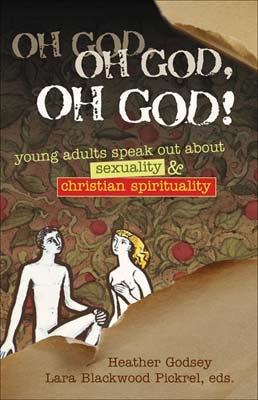
ST. LOUIS, MO- Sexuality and religion as subjects of discussion are taboo enough on their own.  Combine the two for discussion in religious settings and you get the new book Oh God! Oh God! Oh God! from Chalice Press.

We all think about it, yet no one wants to talk about it with other Christians.  It’s time to start talking. Oh God, Oh God, Oh God!: Young Adults Speak Out about Sexuality and Christian Spirituality is edited by Kansas City author Lara Blackwood Pickrel and Knoxville author Heather Godsey.  Oh God is the first book in the new Where’s the Faith? series written by young adults, for young adults.

Discussions about sex, sexuality, and theology are taboo in many churches. What about the tensions felt between the commitments of love, dating, marriage, or parenthood and living lives of faith and integrity?  The essays (written by young adults in their late teens, twenties and thirties) in Oh God, Oh God, Oh God! address multiple perspectives on love, dating, marriage, parenthood, sex, and sexuality, as well as look at the history of the church’s struggle with human sexuality from a fresh perspective.

This book will enlighten readers and provide thought-provoking ideas that can generate conversation on what is normally a taboo topic in church and Christian circles.

Publishers Weekly recently gave a glowing review of Oh God saying:

Finally, an edgy book on the Christian tradition and dating, sex, the single life, and other related topics that takes a different path from standard evangelical Christian courtship and anti-dating manuals. The essays in this edited volume are short, personal, practical, and brimming with ideas and advice about how to tackle any number of significant topics during the young adult years, from hookup culture to surviving sexual abuse.”

Meet one of the editors of Oh God!, Lara Blackwood Pickrel, and one of the series editors for the Where’s The Faith? series, Brandon Gilvin, at a book release and book signing party on February 26, 2010 at Hillside Christian Church (900 Northeast Vivion Road, Kansas City, MO 64118).

The event will begin with a reception at 6:30 pm, a discussion and question/answer session at 7:00 pm, and a book signing at 7:45 pm.  This event is free and open to the public.

You can also meet and talk with Oh God! Co-editor Lara Blackwood Pickrel at a book signing event on February 27, 2010 at Cokesbury Bookstore (7431 W. 91st St.,
Overland Park, KS 66212-2031).  This book signing will take place from 12:30 to 3:00 pm.

Lara Blackwood Pickrel is an ordained minister of the Christian Church (Disciples of Christ) and currently serves as Associate Minister for Youth & Young Adults at Hillside Christian Church in Kansas City, MO.

Heather Godsey is an ordained minister in the Christian Church (Disciples of Christ) working in children’s ministries and as a college chaplain in Knoxville, TN.

Brandon Gilvin is an ordained minister in the Christian Church (Disciples of Christ) and currently serves as Associate Director for Week of Compassion.  Brandon resides in the Kansas City area.

For more information or to order Oh God, Oh God, Oh God!: Young Adults Speak Out about Sexuality and Christian Spirituality (978-08272-27309, $16.99) call 1-800-366-3383 or visit http://www.ChalicePress.com.

Christian Board of Publication publishes educational resources that support congregational ministries for bringing unbelievers to awareness, seekers to belief, and believers to deeper faith and commitment to God through Jesus Christ. Through its Chalice Press imprint, CBP publishes a variety of resources for pastors, seminarians, and laypersons.  CBP is a general ministry of the Christian Church (Disciples of Christ).

In the Flock…

Usually when I think about flocks, I think of sheep.  Wooly, bleating, earth-bound sheep.

And with all the time I’ve spent steeping in religious literature and imagery, when I think of sheep, my thoughts quickly turn to the Shepherd.

The Shepherd was/is definitely not a sheep.

I mean, if we stick with the sheep/shepherd metaphor, where sheep are the people (us) and the Shepherd is Jesus… well, I can’t help but notice that the Shepherd is not merely a sheep with leadership responsibilities.  The Shepherd is an entirely different species.   On his two legs, the Shepherd leads – and the sheep, on four, follow.  The Shepherd discerns and the sheep trust.  And, most importantly, the sheep don’t aspire to be like the Shepherd.  After all, how could they?  No matter how good they are, they will always just be sheep.

Now, don’t get me wrong.  I think that there are plenty of ways that the traditional “Good Shepherd” image of Jesus works well.  Knowing how frequently I have been lost in the darkness of my own doubts, sins and self-loathing, I find it both heartwarming and astounding to think that the Good Shepherd loves me enough to search for me and bring me back into the light.  When I am worn out and scraped up from the brambles and thickets that pepper a day’s journey, it is a relief to know that I can look to the Shepherd for direction.  And if I lived in an agrarian culture, I’m sure I might find more useful insights via the metaphor.

But I don’t.  I live in a city.  And as a pastor (a title that has its roots in a more agrarian time and place), I need to know that Jesus thinks I really can be more like him – that I am more than just a sheep.

I guess, what I’m trying to say is that I need a new metaphor – and this winter I may have found it.

—————

This is my first winter in Kansas City, and it has been very different from those Texas and Arkansas winters I had come to know.  It is colder.  We’ve had a ton of snow.  Everything feels grayer and the air has a salty bite to it (as a result of some complex equation involving wind and road salt).  But the biggest difference – at least the one that has struck me the most – is the geese.

I was aware of geese before moving to KC.  I’d seen an occasional flock pass high overhead in Fayetteville, and I touched a few at petting zoos in my childhood.  But those experiences pale in comparison with the blustery goose-filled wonderland that is a Kansas City winter.

They are simply everywhere.  For the past three or four months, a day has not passed that didn’t contain the majestic, fluid “v” of a flock in flight.  And the sounds!  Oh, the sounds!  Harmonious honking precedes each “v” – building in volume until the formation finally comes into view through the trees. And then, there they are!  Soaring as they honk, one to another – keeping every member of the flock informed of progress and direction, encouraging and checking in, and, periodically, calling a new leader to the front of the ‘v”.

If there is a goose in the flock that leads more than the others, that leader is still a goose.  That leader keeps the flock safe and focused with the sound of its voice, while also teaching and encouraging the others to communicate.  That leader periodically moves to a different position in the “v” – and trusts one of the followers to lead for a while.  And the flock soars!

The more I watch the geese, the more I wonder if Jesus is better described like a goose – rather than a Shepherd…

…Jesus in the flock instead of Jesus separate from it.

…Jesus honking out encouragement and direction when we need it.

…Jesus equipping and trusting us to soar!


This week, at least, that metaphor works for me.


Composting our Hurts…

I’ve thought a great deal about forgiveness lately.  As a topic of discussion, it comes up in churches all the time.  We pray each week that we will be forgiven our debts (or sins/trespasses) as we forgive those in need of our forgiveness.  One of the women’s groups does a book study on how to forgive.  A sermon series stresses the need to forgive ourselves as well as others.  We talk all around the edges of it, but rarely get down to the hard work of actually forgiving.

Why?  Why all the talk and so little action?

Because forgiveness is hard.  And messy.  And a process.

In a way, it’s a lot like composting versus throwing something in the trash.  Many of us don’t like to compost.  It’s a lot of work, the process sounds kind of gross, and there is real possibility that the compost heap is going to stink.  It seems far cleaner and more sanitary to take that banana peel or that wet filter full of coffee grounds and put it in the trash.  While it might stink up the kitchen for a day or two, ultimately a team of sanitation workers will whisk the neatly tied trash bag off to the landfill, at which point our trash is gone.

Or is it?

While it is certainly easier to send something off to the landfill (out of sight, out of mind!), the structure of a landfill pretty much ensures that your trash will stay there forever.  Forever.  As in, everything is so tightly packed and oxygen deprived that it will never go away.  In a landfill, your trash becomes immortal.  And when we put hurts off to the side, or stuff them deep down inside ourselves so that we don’t have to deal with them, our hurts become immortal too.  Without light and air and attention, they will never truly go away.

In contrast, the messy process of composting helps the same stuff get broken down.  Moisture, oxygen, repeated stirring and mixing – all of these things break the peel or the filter down into nourishment for new life.  And when we face our hurts, our pain, our failures, and put them in a safe place (where they don’t dominate our lives but  can still be revisited) – they too begin to break down and provide nourishment for new life and new ways of being.  Instead of some vampy immortality (where there is no death but there is also no growth), our hurts take on a very organic immortality where death is not avoided and growth is guaranteed!

When someone hurts us or betrays our trust, a wink and a handshake or ignoring the problem won’t make it go away.  Each and every day we have to sift through the hurt and choose to forgive all over again – until the day comes when we don’t have to because the hurt has dissolved and slipped away.

And therein lies one of God’s many mysteries – in the middle of the hard, messy work of forgiving, we miraculously become that which we seek:

Forgiven.